
Your car’s factory speakers may be suitable for everyday listening, but they often lack the clarity, detail, and powerful sound that music lovers expect. Upgrading your car speakers can improve your entire driving experience by delivering cleaner vocals, deeper bass, and more balanced sound.
However, choosing the right speakers is not only about selecting the biggest or most powerful option. Speaker size, power handling, sensitivity, compatibility, and installation all play an important role. This guide explains what you should consider before upgrading your vehicle’s sound system.
The first step is to find out which speaker sizes are compatible with your vehicle. Different vehicles use different speaker sizes and mounting depths, so not every speaker will fit directly into your existing door or dashboard locations.
Common car speaker sizes include:
Before purchasing, check your vehicle’s make, model, and year. You should also consider the available mounting depth and whether an adapter or mounting bracket is required.
A professional installation service can help confirm compatibility and ensure the speakers are fitted securely without damaging the vehicle’s interior.
When comparing speakers, you may see both RMS power and maximum or peak power ratings.
RMS power is generally the more useful number because it shows how much continuous power the speaker can handle during normal use. Peak power represents the maximum amount of power the speaker may handle for a short period.
For example, a speaker rated at 50W RMS is designed to handle approximately 50 watts continuously. If you are using an external amplifier, the speaker’s RMS rating should be compatible with the amplifier’s output.
Choosing speakers with suitable power handling can help provide clearer sound and reduce the risk of distortion or damage.
Speaker sensitivity indicates how efficiently a speaker converts power into sound. It is usually measured in decibels, or dB.
Higher-sensitivity speakers can produce more volume using less power. This can be useful if you are keeping your factory head unit and do not plan to install an external amplifier.
If you are adding a powerful amplifier, you may have more flexibility when choosing speakers. The overall system should still be matched correctly to achieve balanced sound quality.
There are two common types of car speaker systems:
Coaxial speakers combine multiple speaker components into one unit. They are often easier to install and are a practical option for upgrading factory speakers.
Benefits include:
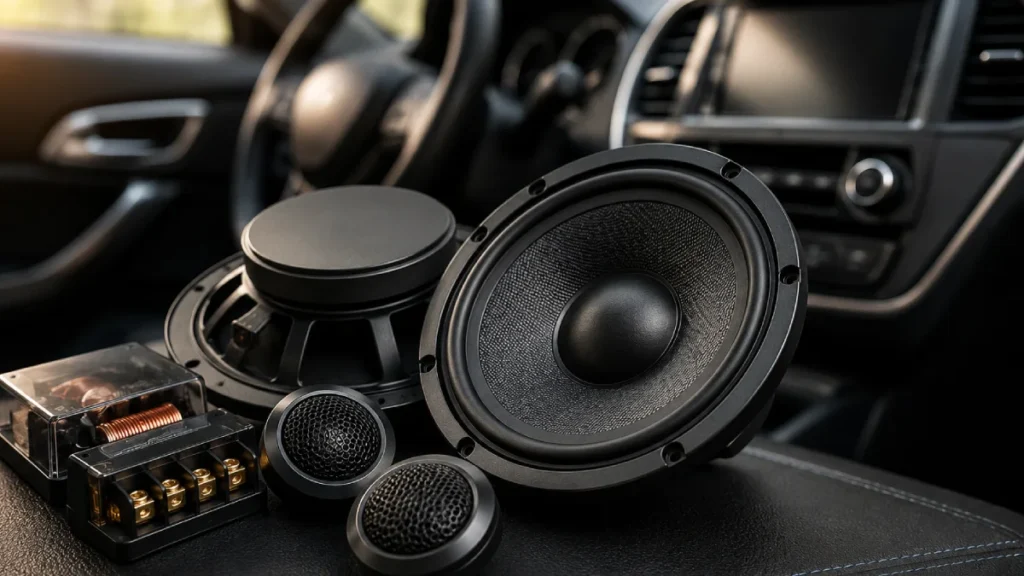
Component speaker systems use separate components, such as woofers, tweeters, and external crossovers. This allows the different sound frequencies to be positioned more effectively throughout the vehicle.
Benefits include:
Component systems may require more installation work, but they can provide a more refined listening experience.
Different speakers are designed with different sound characteristics. Some may focus on strong bass, while others may provide clearer vocals or detailed high frequencies.
Consider what you listen to most often:
The best speaker is not always the most expensive option. It should match your music preferences, vehicle, and overall audio system.
Even high-quality speakers may not perform as expected if they are installed incorrectly. Loose mounting, poor wiring, incorrect polarity, or inadequate sound insulation can affect audio quality.
Professional installation can help ensure:
Upgrading your car speakers is one of the best ways to improve your daily driving experience. By considering speaker size, RMS power, sensitivity, speaker type, and installation requirements, you can choose a system that delivers better sound for your vehicle.
Whether you want clearer vocals, stronger bass, or a complete audio upgrade, selecting compatible equipment and having it installed correctly can help you enjoy every journey even more.